
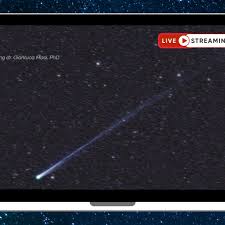
Explore the latest developments concerning Watch comets Lemmon.
Watch comets Lemmon and SWAN make their closest approach to Earth today
The livestream is scheduled to start at 1:30 p.m. EDT (1730 GMT) on Oct. 20.
When you purchase through links on our site, we may earn an affiliate commission. Here’s how it works.
Two comets, C/2025 A4 (Lemmon) and C/2025 R2 (SWAN), are about to reach their closest approach to Earth and you can watch the action unfold live online.
Astronomer Gianluca Masi and his Virtual Telescope Project will host a special livestream on Oct. 20 beginning at 1:30 p.m. EDT (1730 GMT) to watch as both comets make a close pass to Earth, making them well placed for observations.
"So far, living in the Northern hemisphere, I could admire C/2025 A6 Lemmon only,but C/2025 R2 SWAN is quickly joining the show and we are ready to amaze everyastronomy lover with our live feed!" Masi told Space.com in an email.
Tuesday is the last day to see Orionid meteor shower before it peaks
Tuesday night is the predicted peak for the Orionid meteor shower.
The best time to look for these bits of Halley’s comet debris hitting our atmosphere is after midnight, especially in the hours before dawn. EarthSky.org states, “In 2025, the Orionid meteor shower should rain down its greatest number of meteors on the morning of October 21. The moon won’t interfere in 2025.”
The Orionids are expected to produce about 10 to 20 meteors an hour. Viewing tips are here.
You do not need any equipment or know how to enjoy the show — just find a place where you can put a lounge chair or a blanket to see the sky. Starting at about 1 a.m. EDT in the East, the constellation for which this meteor shower is named — Orion the Hunter — hangs low above the horizon and will rise higher as the night progresses. A meteor that is part of the shower can be traced back to Orion. Sporadic meteors that are not part of the shower can be seen during the night as well.
MAXGROOM Bikini Trimmer for Women IPX7 Waterproof Body Underarm Legs Pubic Hair Trimmer Detachable Head Painless Electric Shaver


How to See Comet Lemmon This October
It was early January 2025 when a faint light spot was observed at the Mt. Lemmon Observatory in Arizona. Follow-up observations revealed that the object was a comet visiting from the outer edge of the solar system, and it was named Comet Lemmon (C/2025 A6). Its “period”—the time it takes to complete its lengthy orbit of the sun—is about 1,350 years.
At first, the comet was so faint that it could only be seen with specialized equipment. But it has brightened rapidly as the months have passed, and by the time fall arrived, it was bright enough to be viewed with binoculars. It will now get brighter still, as it gets closer to both the Earth and the sun, and may even become visible with the naked eye.