
Explore the latest developments concerning Space Weather Story.
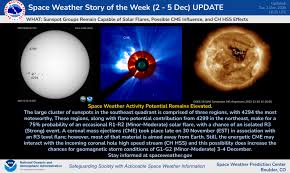
Space Weather Story of the Week (2-5 Dec) Update
A G2 (Moderate) Watch is in effect for 3 – 4 December UTC-days. These Watches are in place due to the potential interaction between a nearby passing coronal mass ejection (CME) and inbound coronal hole high speed stream (CH HSS). Stay space weather aware at spaceweather.gov
How to Watch the Northern Lights
Our editors will review what you’ve submitted and determine whether to revise the article.
The northern lights, or aurora borealis, occur when particles from the solar wind interact with atoms in the upper atmosphere. The solar wind particles are protons and electrons. These particles are charged. Most are deflected by Earth’s magnetic field, but some are funneled toward the magnetic poles. They collide with oxygen and nitrogen atoms, knocking away electrons from these atoms to leave ions in excited states. These ions emit radiation at various wavelengths, creating the characteristic colors (red and greenish blue) of the aurora.
Hot Pot Electric with Steamer, Non-Stick Fryer Pan, 1.5L Rapid Noodles Electric Pot for Steak, Soup with Power Adjustment


Today's biggest science news: Vaccine skeptics get hep B win | Comet 3I/ATLAS surprises | 'Cold Supermoon' pictures
When you purchase through links on our site, we may earn an affiliate commission. Here’s how it works.
Welcome back, science fans. We’re here with news of fresh geomagnetic storms, as Earth was hit by one solar flare last night and many more — alongside a coronal mass ejection — appear to be in the offing.
Coronal mass ejections (CMEs) are large, fast-moving clouds of magnetized plasma that occasionally get spat out into space by the sun alongside solar flares — powerful explosions on our star's surface triggered when solar magnetic loops snap in half like an overstretched elastic band.
Last night’s flare was a surprise, spaceweather.com reports, coming from a new sunspot on the sun’s northern surface that appeared to be harmless until it exploded. The flare ionized the Earth’s atmosphere and caused a radio blackout over Australia.
For more detailed information, explore updates concerning Space Weather Story.