

















Explore the latest developments concerning Interstellar Visitor 3I/ATLAS.
Interstellar Visitor 3I/ATLAS Just Got Even Weirder, And May Contain 10-Billion-Year-Old Material
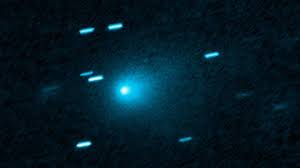
Exiled interstellar visitors like comet 3I/ATLAS are time capsules from the cosmos at large, yeeted from their exosolar homes by an unknown cataclysm and forced to drift through lonely space for billions of years, perhaps.
If they're lucky, they may cross paths with another star, such as the Sun, and warm themselves at our solar hearth for a short while before speeding back out into darkness.
This is lucky for us, too, since we get an unprecedented look at a chunk of an alien Solar System, which may have formed long before ours with chemistry unlike anything glimpsed before.
Webb links interstellar comet 3I/ATLAS to worlds beyond Neptune through similar ice signatures
This article has been reviewed according to Science X's
editorial process
and policies.
Editors have highlighted
the following attributes while ensuring the content's credibility:
A Southwest Research Institute–led study used NASA's James Webb Space Telescope to examine ice grains streaming from interstellar comet 3I/ATLAS, just the third object from beyond our solar system ever identified. The observations point to tiny aggregates of water ice and dust, about a micron or smaller.
The grains' spectral characteristics differ from those of ice grains in most previously studied comets but resemble the spectra of some icy worlds beyond Neptune. The results suggest that the icy building blocks of planets around other stars may share a common range of physical properties with those in our own solar system, with tiny grains ranging in composition from relatively pure ice to ice mixed with dust.
Vocabulary Builder – Learning: Master 19000+ English words with Tinder-style swipe learning, 4 quiz types, and smart spaced repetition. GRE, TOEFL, IELTS & SAT prep included!

Deuterium-to-hydrogen ratio in 3I/ATLAS methane is 13 times higher than in 67P — ScienceAlert
Scientists have found that the deuterium-to-hydrogen ratio in methane from the interstellar comet 3I/ATLAS is 13 times higher than that of comet 67P/Churyumov–Gerasimenko. As ScienceAlert reports, this ratio is higher than that of any known body in the Solar System.
A research team led by scientists from NASA's Solar System Exploration Division analyzed the chemical composition of the coma, the comet's gaseous envelope. They used the infrared capabilities of the James Webb Space Telescope.
The observations were conducted in late December 2025, when 3I/ATLAS was passing through the asteroid belt between Mars and Jupiter. At that time, it was approximately 2.5 times farther from the Sun than Earth.
For more detailed information, explore updates concerning Interstellar Visitor 3I/ATLAS.

0 Comments