


















Explore the latest developments concerning Scientists discover potentially.
Scientists discover potentially massive dwarf planet candidate hiding beyond Pluto
This material may not be published, broadcast, rewritten, or redistributed. ©2026 FOX News Network, LLC. All rights reserved. Quotes displayed in real-time or delayed by at least 15 minutes. Market data provided by Factset. Powered and implemented by FactSet Digital Solutions. Legal Statement. Mutual Fund and ETF data provided by LSEG.
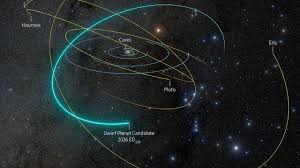
Astronomers have discovered a possible dwarf planet beyond Pluto that could be among the largest of its kind ever found in the outer solar system. The object, known as 2026 ED138, could measure up to 930 miles across.
A powerful new telescope has discovered a dwarf planet candidate beyond Pluto — and scientists say it could be among the largest of its kind ever found in the reaches of our solar system.
Astronomers Just Discovered a New Hidden World Beyond Neptune
The Vera C. Rubin Observatory’s detection of a possible dwarf planet is just the start of many more discoveries in our cosmic neighborhood.
Around 4.3 billion miles from the sun, hiding beyond the orbit of Neptune, a mysterious world was spotted flitting about in the darkness by the omnipotent Vera C. Rubin Observatory. This orb is very likely to be the solar system’s newest dwarf planet—a large, round object that doesn’t quite fit the official definition of a full-blown planet.
Astronomers announced the discovery of this cosmic island—which, for now, is referred to as 2026 ED138—earlier this week made at a meeting of the American Astronomical Society’s division for planetary sciences in Spokane, Washington. If upcoming observations with other telescopes verify its size and round shape, then it would join an exclusive club of just five other confirmed dwarf planets, each formally recognized by the International Astronomical Union: Pluto, Ceres, Eris, Haumea, and Makemake.
Vocabulary Builder – Learning: Master 19000+ English words with Tinder-style swipe learning, 4 quiz types, and smart spaced repetition. GRE, TOEFL, IELTS & SAT prep included!

NSF–DOE Vera C. Rubin Observatory Reveals Its First Dwarf Planet Candidate in Our Solar System
The U.S. National Science Foundation (NSF) and the U.S. Department of Energy (DOE) Office of Science will support Rubin Observatory in its operations phase to carry out the Legacy Survey of Space and Time. They will also provide support for scientific research with the data. During operations, NSF funding is managed by the Association of Universities for Research in Astronomy (AURA) under a cooperative agreement with NSF, and DOE funding is managed by SLAC National Accelerator Laboratory (SLAC), under contract by DOE. Rubin Observatory is operated by NSF NOIRLab and SLAC.
NSF is an independent federal agency created by Congress in 1950 to promote the progress of science. NSF supports basic research and people to create knowledge that transforms the future.
For more detailed information, explore updates concerning Scientists discover potentially.

0 Comments